Best Hearing Aids for Profound Hearing Loss in 2026
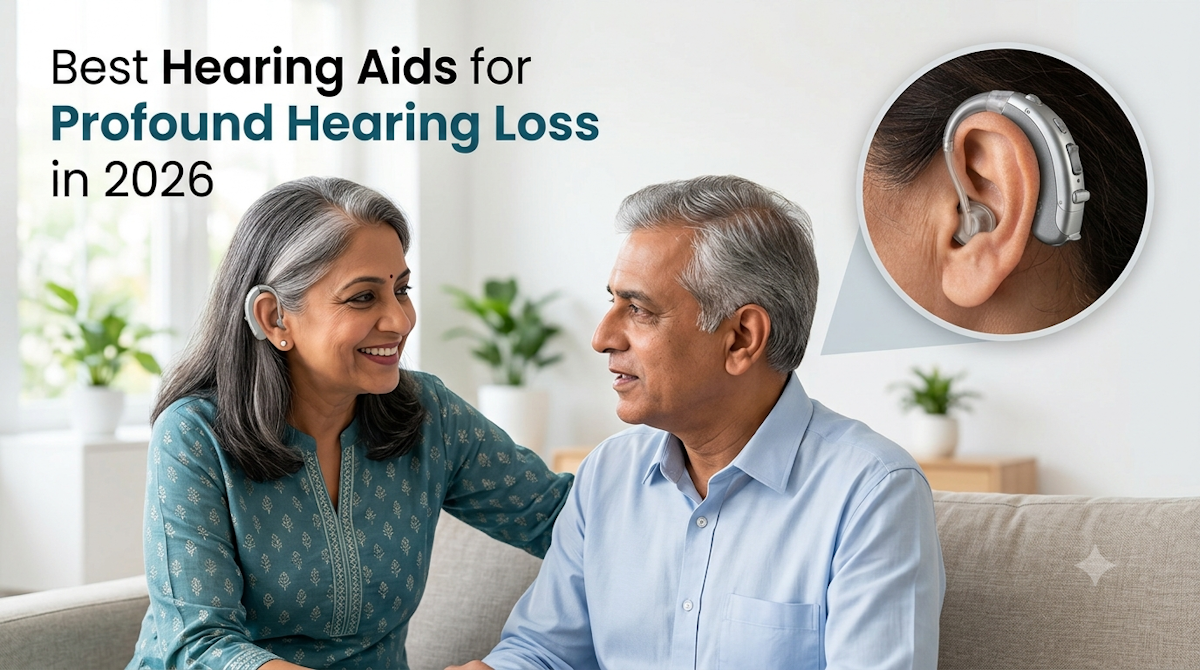
The best hearing aids for profound hearing loss in 2026 are ultra-power or "super power" BTE devices such as the Phonak Naída Lumity UP, Signia Motion Power IX, Starkey Genesis AI Ultra Power, and Widex Moment Super Power — engineered for maximum output (often 90+ dB gain), and for many patients a cochlear implant evaluation should also be discussed alongside hearing aids.
Profound hearing loss (thresholds above 90 dB) means even loud sounds — a truck horn, a shouted conversation — may go unheard without maximum amplification. This is the most challenging range to treat with a hearing aid alone, and audiologists often assess whether a cochlear implant may offer better outcomes, especially for severe-to-profound sensorineural loss where hearing aids provide only limited benefit.
Understanding Profound Hearing Loss
Profound hearing loss is the most severe classification on the standard audiogram scale. At this level, someone may only detect very loud environmental sounds — an airplane taking off, a jackhammer — and even these may register more as vibration or pressure than clear sound. Speech, even shouted at close range, is typically inaudible without amplification. Causes include:
- Severe congenital or genetic sensorineural hearing loss
- Advanced, long-term progression of age-related or noise-induced hearing loss
- Certain infections (such as meningitis) affecting the auditory nerve or cochlea
- Significant head trauma or acoustic trauma
- Progressive conditions like otosclerosis reaching an advanced stage
Because profound loss so significantly limits access to spoken communication, early and thorough evaluation — including discussion of both hearing aid and cochlear implant pathways — is especially important, rather than defaulting to the most powerful hearing aid available without considering alternatives.
What Profound Hearing Loss Devices Need
- Maximum power output (ultra/super power rating): The highest gain tier manufacturers produce, well beyond standard or even "power" tier devices.
- Advanced feedback management: Essential at maximum volumes to prevent whistling, which becomes a much greater risk as amplification approaches the device's output ceiling.
- Robust, larger BTE casing: Higher-output receivers and larger batteries require BTE form factors — ITE/RIC styles rarely have enough physical headroom for this level of amplification.
- Tactile/vibrotactile or visual alert accessories: Often recommended alongside the hearing aid for safety (doorbells, alarms, smoke detectors) since even ultra-power devices may not make every critical sound reliably audible.
- Cochlear implant candidacy assessment: For some profound-loss patients, particularly those with limited benefit from hearing aids after a trial period, a cochlear implant referral may be the more effective long-term solution for speech understanding.
Hearing Aid vs. Cochlear Implant: What's the Difference?
A hearing aid amplifies sound acoustically through the ear canal, relying on whatever functioning hair cells remain in the cochlea. A cochlear implant bypasses damaged parts of the inner ear entirely, using a surgically implanted electrode array to stimulate the auditory nerve directly. For profound sensorineural loss where very few functioning hair cells remain, a hearing aid — even an ultra-power one — may simply not have enough biological material to amplify effectively, in which case a cochlear implant can provide substantially better speech understanding. This is a decision best made jointly with an audiologist and, where relevant, an ENT surgeon, typically after a documented trial period with hearing aids.
Top Hearing Aids for Profound Hearing Loss in 2026
1. Phonak Naída Lumity UP (Ultra Power)
Phonak's highest-output device, purpose-built for profound loss, with AutoSense OS 5.0 and strong wireless connectivity even at maximum gain settings — a rarity, since most ultra-power devices sacrifice smart features for raw output.
2. Signia Motion Power IX
Signia's most powerful BTE platform, combining ultra-power amplification with Augmented Xperience processing for clearer speech even at high output levels, where distortion is a common problem with less advanced processors.
3. Starkey Genesis AI Ultra Power
Starkey's top-tier power device, pairing maximum amplification with AI-based Edge Mode and health-monitoring features, useful for the many profound-loss patients who are older adults with additional health monitoring needs.
4. Widex Moment Super Power / Beyond Power
Retains Widex's natural sound signature at ultra-power output — a strong option for patients who find other maximum-gain devices sound harsh, tinny, or distorted at high volumes.
5. ReSound Omnia Ultra Power
ReSound's highest-gain configuration, focused on preserving natural sound quality (Organic Hearing) even at profound-loss amplification levels, rather than the flat, processed sound older ultra-power devices were known for.
6. Beltone Serene/Achieve Ultra Power
A dependable, value-oriented ultra-power option for patients seeking maximum amplification at a lower price point than flagship brands, without sacrificing core safety features like feedback control.
Indicative Pricing in India (INR)
| Brand & Model Line | Approx. Price Range (INR) |
|---|---|
| Phonak Naída Lumity UP | ₹95,000 – ₹2,80,000 |
| Signia Motion Power IX | ₹85,000 – ₹2,60,000 |
| Starkey Genesis AI Ultra Power | ₹1,00,000 – ₹2,90,000 |
| Widex Moment Super/Beyond Power | ₹90,000 – ₹2,70,000 |
| ReSound Omnia Ultra Power | ₹80,000 – ₹2,50,000 |
| Beltone Serene/Achieve Ultra Power | ₹65,000 – ₹2,20,000 |
Pricing depends on technology tier and individual fitting requirements. ADIP Scheme subsidy support is available for eligible beneficiaries, and cochlear implant options may be covered under separate government or insurance schemes.
What to Expect During Assessment and Fitting
Profound hearing loss evaluation typically involves more extensive diagnostic testing than lower loss levels — including detailed audiometry, speech discrimination testing, and often a structured hearing aid trial period before any cochlear implant discussion. Family involvement is especially important at this stage, both for communication support and for helping evaluate real-world benefit during the trial. Patients should expect several follow-up visits for fine-tuning, since profound loss fittings often require more adjustment than any other category to balance maximum audibility with comfort and safety from feedback.
Why Get Fitted at Soft Hear
Profound hearing loss requires the most careful, expert assessment of any hearing loss range — including an honest evaluation of whether hearing aids alone will be sufficient. Soft Hear provides:
- Assessment by RCI-registered audiologists experienced in profound loss and cochlear implant candidacy screening.
- Real Ear Measurement (REM) to verify maximum safe amplification is reaching the eardrum accurately.
- A free hearing test as the first step in classifying loss severity and exploring the right options.
- ADIP Scheme guidance for eligible patients.
- Clinics across Delhi, Gurugram, Noida, Panipat, Pune, Nagpur, and Navi Mumbai.
Frequently Asked Questions
What decibel range is profound hearing loss?
Profound hearing loss refers to thresholds above 90 dB, where even loud sounds like shouting or a car horn may be difficult or impossible to hear without maximum amplification.
Do hearing aids work for profound hearing loss, or do I need a cochlear implant?
It depends on the individual—ultra-power hearing aids help many people with profound loss, but for some, particularly those with severe-to-profound sensorineural loss and limited benefit from hearing aids, a cochlear implant evaluation may offer better speech understanding. An audiologist assessment is essential to determine the right path.
Which brand makes the most powerful hearing aids?
Phonak Naída Lumity UP, Signia Motion Power IX, and Starkey Genesis AI Ultra Power are among the highest-output devices currently available for profound hearing loss.
Can profound hearing loss hearing aids be invisible or discreet?
No—profound loss requires BTE (behind-the-ear) ultra-power devices due to the larger components needed for maximum output; invisible or in-canal styles do not have enough power headroom for this range.
Is treatment for profound hearing loss covered under the ADIP Scheme?
Many ultra-power hearing aid models qualify under ADIP Scheme guidelines for eligible beneficiaries. Soft Hear's audiologists can guide you through eligibility and, where relevant, discuss cochlear implant referral pathways.
How long is a typical hearing aid trial before considering a cochlear implant?
This varies by individual, but audiologists generally recommend a documented trial period of several weeks to a few months with an appropriately fitted ultra-power hearing aid before concluding that a cochlear implant evaluation is the better path forward.